Quick Answer
Julii, Sterbai, and Panda Corydoras differ significantly in temperature tolerance, size, and breeding difficulty, making species selection critical for community tank compatibility. Sterbai Corydoras tolerate the highest temperatures at 79–86°F, making them uniquely suitable as discus companions, while Panda Corydoras prefer cooler water at 68–77°F. All three species require groups of 6 or more and fine sand substrate to protect their sensitive barbels.
The Corydoras genus offers dozens of species, but three are perennial favorites: Julii, Sterbai, and Panda. While all are peaceful, social bottom‑dwellers, they differ significantly in their natural habitat, temperature requirements, and overall hardiness. This guide will help you decide which cory fits your tank best.
Quick Comparison Table
Species: Julii Cory
Scientific Name: Corydoras julii
Adult Size: 2-2.5 inches
Preferred Temp: 72-78°F (22-26°C)
Hardiness: Moderate (sensitive)
Distinct Feature: Small, scattered black dots; black stripe through eye
Ideal For: Soft, neutral water tanks; dedicated cory keepers
Species: Sterbai Cory
Scientific Name: Corydoras sterbai
Adult Size: 2.5-3 inches
Preferred Temp: 75-82°F (24-28°C)
Hardiness: High
Distinct Feature: White or yellow‑orange spots on dark body; orange pectoral fins
Ideal For: Community & discus tanks; beginners; high‑temperature setups
Species: Panda Cory
Scientific Name: Corydoras panda
Adult Size: 2 inches
Preferred Temp: 68-77°F (20-25°C)
Hardiness: Moderate (delicate when small)
Distinct Feature: Bold black patches on eyes, dorsal fin, and tail
Ideal For: Cooler tanks; nano aquariums; panda lovers only
Detailed Analysis
Appearance
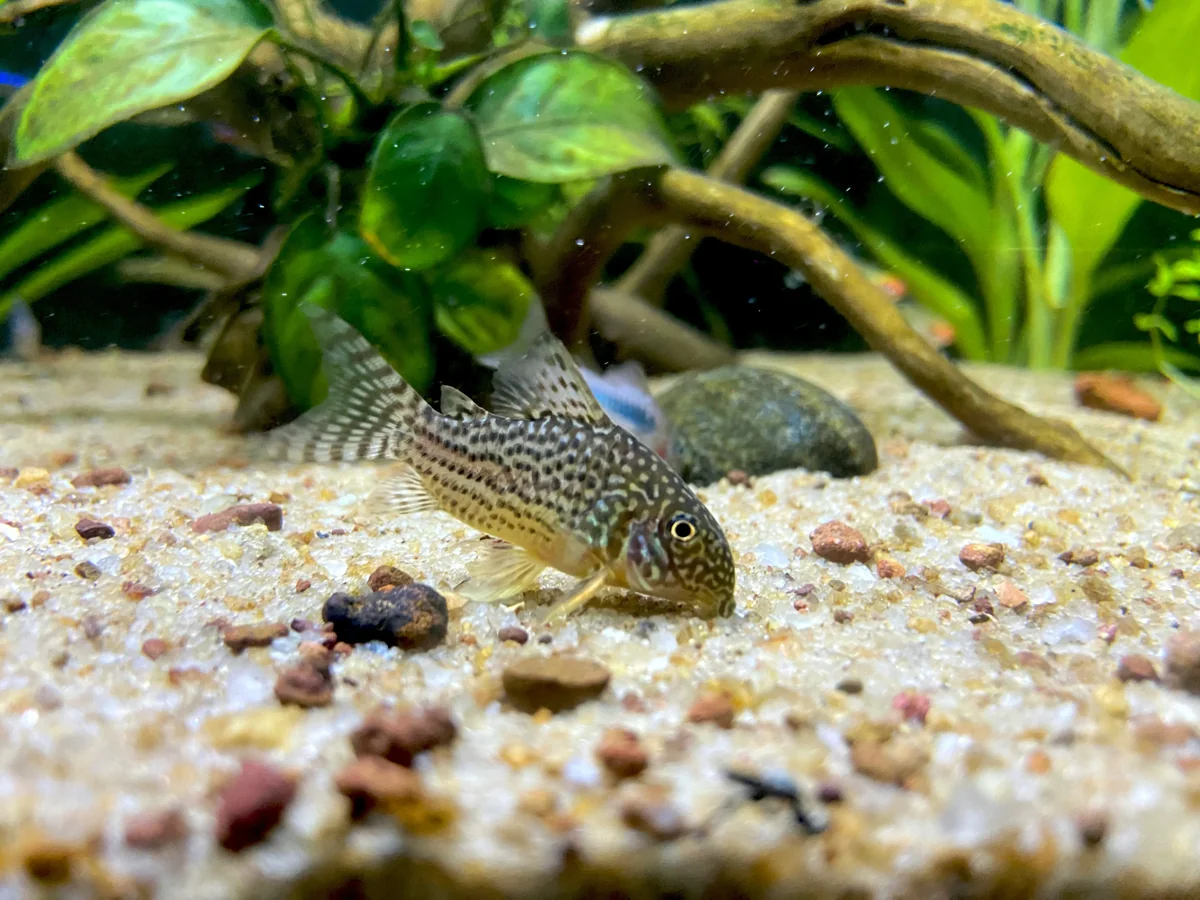
Julii corys have an elegant, almost reticulated pattern of small, interconnected dark spots. True Julii (Corydoras julii) are rarer; most "Julii" sold are actually the similar but distinct Corydoras trilineatus or Three-Line Cory. Sterbai corys have large, distinct white or yellow‑orange spots on a dark body, along with stunning orange accents on their pectoral fins. Panda corys have the most striking contrast, with bold black patches on their eyes, dorsal fin, and tail base against a white or pinkish body.
Hardiness and Sensitivity
Sterbai are widely considered the hardiest of the three. They tolerate a wider range of water parameters, are less prone to bacterial infections, and thrive in both soft and moderately hard water. Panda corys are known to be delicate, especially as juveniles. They are very sensitive to sudden changes in water chemistry and can be challenging for a beginner. True Julii are also moderately sensitive, requiring very clean, stable conditions, though the more common C. trilineatus is somewhat hardier.
Temperature Requirements: The Biggest Factor
The most critical difference is their temperature range. Panda corys originate from cooler, fast‑flowing waters and prefer temperatures below 77°F. In a warm community tank (78-82°F), Pandas are prone to stress, disease, and shortened lifespans. Sterbai corys are the only one of the three that thrives in high temperatures, making them the exclusive choice for tanks with discus, rams, or other Amazonian fish that need warm water. Julii/trilineatus corys are intermediate, preferring 72-78°F, which overlaps with a standard community tank.
Breeding
Sterbai are reasonably easy to breed with dedicated conditioning and a cooler water change to simulate rain. Pandas are also known to be prolific spawners in stable environments, but their eggs and fry are very sensitive. Julii/trilineatus are considered by many to be the hardest to breed of the three, requiring very soft, acidic water and precise triggers to spawn.
Which Should You Choose?
Choose Sterbai Corys if: Your tank temperature is consistently above 78°F (e.g., discus or ram tanks). You are a beginner looking for the hardiest, most forgiving cory. You appreciate the striking spotted pattern and orange fins.
Choose Panda Corys if: Your tank is unheated or kept at cooler room temperatures (68-75°F). You have a well‑established, mature, and very stable aquarium. You are prepared for their potential sensitivity and have the experience to handle it.
Choose Julii/Trilineatus Corys if: Your tank is a standard community tank at 72-78°F. You want a classic, elegant corydoras. You have good water quality and are ready to provide the stable environment they need to thrive.
Essential Corydoras Care for Any Species
Regardless of the species you choose, certain rules apply to all corydoras: Substrate: Use fine sand or smooth, rounded gravel. Sharp gravel will damage their delicate barbels (whiskers), leading to infection. Group Size: They are highly social fish that must be kept in a group. The absolute minimum is 5-6 of the same species. Groups of 10 or more will display the most natural, confident behavior. Feeding: They are not just scavengers. You must provide dedicated sinking foods such as sinking pellets (e.g., Hikari Sinking Wafers), catfish granules, and frozen foods like bloodworms.
Knowledge Journey
Recommended Next Steps
Move from reading to action with related calculators, fish profiles, and quiz-based recommendations.
Calculator
Aquarium Quarantine Duration & Protocol Calculator
One sick fish can crash an entire display tank in days. This calculator generates a personalized quarantine timeline and prophylactic medication schedule based on where you bought your fish, what species they are, and what symptoms — if any — are already visible. Know exactly what to treat, when to treat it, and when it is genuinely safe to move your new fish into your main tank.
Calculator
Aquarium Heater Wattage Calculator
Prevent underpowering or overheating your tank by calculating the ideal heater wattage based on your actual temperature delta – the difference between room temperature and target tank temperature. Get a safe wattage recommendation and learn why two smaller heaters are safer than one large one.
Calculator
Fish Growth Rate Estimator
Most fish are sold as tiny 1-inch juveniles that look harmless in the store — but some will reach 12, 18, or even 24 inches within a year. Enter your fish's species category and current size to visualize exactly how fast it will grow, when it will outgrow your tank, and what size aquarium it will actually need as an adult.
Quiz
Fish Compatibility Quiz
Find beginner-friendly fish that match your tank size, setup, and experience level.
Quiz
Fish Quiz Hub
Choose a guided quiz and get personalized fish care next steps.
Calculator
Ammonia Toxicity Calculator (Free NH3)
Enter your test kit reading (TAN), pH, and temperature — get an instant SAFE or LETHAL verdict for Free Ammonia (NH3). Built for API Master Kit users, cichlid tanks, reef setups, and fish breeders.